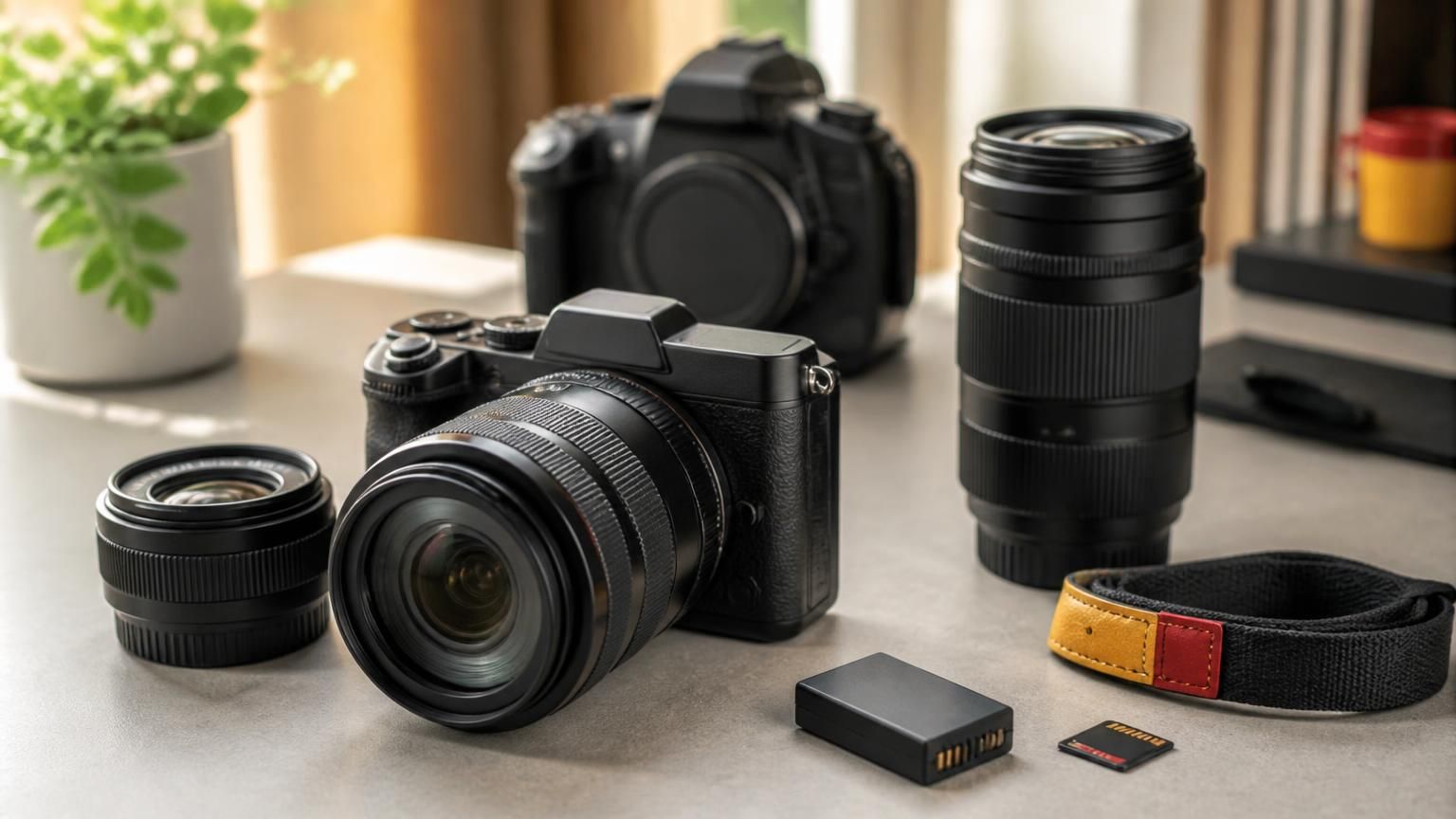
If you already own DSLR lenses, do not assume that changing to mirrorless means replacing everything. Some manufacturers provide adapters, but autofocus, stabilisation, aperture control and compatibility can vary by lens and body. Check the manufacturer's compatibility list for the exact combination.
3. APS-C vs full-frame: what changes?
Sensor size affects more than the megapixel count.
| Sensor format | Typical dimensions | Practical implications |
|---|
| APS-C | Approximately 24 × 16 mm, depending on manufacturer | Smaller and often lighter bodies/lenses; useful reach from a given lens angle of view; usually a lower system cost |
| Full-frame | Approximately 36 × 24 mm | Larger image area; can offer more low-light flexibility and shallower depth of field with suitable lenses; bodies and lenses may cost more and weigh more |
A larger sensor can collect more light for a comparable exposure and can make it easier to achieve a shallow depth of field, but the result also depends on lens aperture, exposure, sensor generation, processing and how the image is viewed.
APS-C is not a “beginner-only” format. It can be a very capable choice for travel, wildlife, sports and everyday photography. The smaller format can also make a telephoto kit more portable. Full-frame is worth considering when you have a clear need for its low-light, depth-of-field or resolution advantages and can budget for the lens system.
Do not pay for full-frame simply because the term sounds more professional.
4. Megapixels are only one part of image quality
More megapixels can help when you crop heavily or make large prints. They do not guarantee better photos in poor light, faster autofocus or more pleasing colours.
Also compare:
- Sensor generation and real-world dynamic range.
- High-ISO noise performance at the image size you will actually use.
- Lens sharpness and maximum aperture.
- Autofocus accuracy and tracking.
- Image processing and colour preferences.
- Rolling shutter and readout behaviour for fast movement or video.
- Your ability to hold the camera steady.
A 24-megapixel camera with a good lens and reliable focus can make better photographs than a higher-resolution body paired with a poor lens or incorrect settings.
5. Lens mount and lens ecosystem: the long-term commitment
The lens mount is the physical and electronic connection between the camera body and lens. It determines which lenses fit directly and which may work through an adapter.
Before choosing a brand or mount, look at the lenses you may want over the next few years:
- A general-purpose zoom for travel and family photography.
- A wide-angle lens for interiors, architecture and landscapes.
- A fast prime lens for portraits and low-light work.
- A telephoto zoom for sports, wildlife and distant subjects.
- A macro lens for close-up product or nature photography.
Check availability and local service for the exact mount. A camera body may look affordable, but a system with limited or expensive lens choices can cost more over time.
Compatibility is system-specific. For example, Nikon documents the use of its FTZ II adapter for compatible F-mount lenses on Z-series mirrorless bodies. Sony documents that APS-C and full-frame E-mount combinations can work, with crop-mode behaviour depending on the camera and lens. These are manufacturer-specific examples, not universal rules for every brand.
6. The kit lens: should you buy it?
A kit zoom is often the most economical way to start because it gives you a useful focal-length range without requiring another lens purchase immediately.
A standard kit zoom can cover:
- Everyday family photographs.
- Travel scenes and street photography.
- Landscapes at the wider end.
- Casual portraits at the longer end.
Its limitations may include a variable maximum aperture, less background blur than a fast prime and reduced reach for distant wildlife or sports.
Do not dismiss the kit lens as useless. Learn its focal lengths and limitations first. If you repeatedly find yourself shooting at the widest aperture, struggling in low light or wishing for a wider or longer view, that tells you which lens to buy next.
7. Autofocus: what matters for real subjects
Look beyond the number of autofocus points. Consider how well the camera acquires and tracks the subjects you photograph.
- Single autofocus (AF-S/One Shot): useful for still subjects.
- Continuous autofocus (AF-C/Servo): useful for moving subjects.
- Eye and face detection: helpful for portraits, family and event photography.
- Animal or bird recognition: useful for wildlife, but performance depends on model, lens and conditions.
- Tracking customisation: helps the camera respond to subjects that move unpredictably or become briefly obstructed.
Try the camera in a store if possible. Check whether the subject you care about is recognised, whether the camera can keep focus as it moves and whether the viewfinder remains comfortable during continuous shooting.
8. Stabilisation: IBIS, lens OIS and electronic stabilisation
Image stabilisation helps reduce blur caused by camera movement. It cannot freeze a moving person or animal; shutter speed still matters.
| System | Where stabilisation happens | What to know |
|---|
| IBIS (in-body image stabilisation) | Camera body moves the sensor to compensate for shake | Can stabilise many compatible lenses, depending on system |
| OIS / optical stabilisation | Stabilising elements move inside the lens | Useful when the lens provides it; effectiveness varies by lens |
| Electronic video stabilisation | Software crops or shifts frames during recording | Can smooth footage but may reduce field of view or introduce artefacts |
Some systems combine body and lens stabilisation. Check the exact camera-and-lens combination and the manufacturer's stated test method. Do not compare “stops” figures across systems without understanding how they were measured.
9. Video specifications: read the fine print
“4K video” is not a complete video specification. Before buying, check:
- Resolution and frame rates: 4K at 24/25/30 fps is different from 4K at 50/60 fps.
- Whether the camera uses the full sensor or crops the image in a selected mode.
- Recording format, bit depth and colour profiles if you plan to edit footage.
- Autofocus performance while recording.
- Rolling shutter when panning or filming fast movement.
- Heat limits and recording duration in the temperatures where you will use it.
- Microphone input and headphone monitoring where required.
- USB charging or power options for longer recording sessions.
- Stabilisation and whether electronic stabilisation crops the image.
For simple family clips, many of these advanced features may not matter. For paid work or long-form video, they can determine whether the camera is suitable.
10. Handling, battery, storage and weather protection
Hold the camera with the lens you expect to use. Check grip depth, button placement, menu navigation, viewfinder clarity, screen articulation and whether the camera balances comfortably.
Also check:
- Battery rating and the cost of genuine spare batteries.
- Whether a charger is included or USB charging is supported.
- Supported SD or CFexpress card type, speed and capacity.
- Whether the camera has one or two card slots.
- Dust and moisture resistance of the body and lens combination.
- Availability of service centres and warranty support in India.
Weather sealing is not the same as waterproofing. Do not expose a camera to rain or dust beyond the manufacturer's stated conditions.
11. Buying a used camera in India
A used body or lens can offer value, but inspect it carefully and keep the purchase documented.
For a camera body:
1. Check the exterior for impact damage, corrosion and loose doors.
2. Inspect the sensor for dust, scratches or marks using a test image and professional inspection where needed.
3. Test every dial, button, port, card slot, screen, viewfinder and battery compartment.
4. Ask for the shutter count where the camera provides it, but do not treat it as the only condition measure.
5. Test autofocus, burst shooting, video recording and file transfer.
6. Check serial number, invoice, ownership history and any remaining warranty.
For a lens:
- Inspect front and rear glass under light for scratches, fungus, haze and separation.
- Check zoom and focus rings for smooth movement.
- Test autofocus and aperture operation.
- Look for decentring by photographing a detailed flat subject at several apertures.
- Confirm the mount and electronic contacts are undamaged.
Prefer a seller who allows a proper test and provides a written invoice or receipt. Avoid a deal that depends on a deposit before inspection.
12. Build the total camera budget in rupees
A camera purchase should be planned as a complete kit. Use this checklist when comparing quotations:
| Item | Why it matters |
|---|
| Camera body | Sensor, autofocus, handling and video features |
| First lens | Determines framing, low-light capability and much of the image look |
| Memory card | Must meet the camera's supported speed and format requirements |
| Spare battery | Useful for long events and travel |
| Bag | Protects the camera and makes carrying practical |
| Cleaning kit | Helps maintain the lens and body safely |
| Tripod | Useful for landscapes, long exposures and stable video |
| External microphone | Needed for better recorded speech and controlled audio |
| Warranty/service | Important for long-term ownership and repair cost |
If your total budget is fixed, do not spend it all on the body. A modest camera with a useful lens and essential accessories is a more complete purchase.
Frequently asked questions
Is mirrorless better than DSLR for beginners?
A current mirrorless camera can be easier to learn with because the electronic viewfinder can preview exposure and modern autofocus systems can track subjects. A DSLR can still be a good-value option, especially if you find a well-maintained body and compatible lenses at a sensible total cost.
Is APS-C enough for professional photography?
Yes, depending on the work, lens choice, lighting and output requirements. Full-frame can offer advantages in some low-light and depth-of-field situations, but professional results depend on the entire system and the photographer's technique.
Should I buy a camera with more megapixels?
Only if your work benefits from the extra resolution, such as large prints or significant cropping. Autofocus, lens quality, sensor performance and handling can matter more for everyday use.
Can I use DSLR lenses on a mirrorless camera?
Sometimes, through a manufacturer-approved adapter. Compatibility varies by lens mount, body and lens generation. Check the official compatibility chart before buying; autofocus, stabilisation or other features may differ.
Is in-body image stabilisation necessary?
It is useful for handheld stills and some video workflows, but not essential for every buyer. Optical stabilisation in a lens, a tripod or faster shutter speed may solve the same problem depending on the situation.
Should I buy a body-only camera or a kit?
If the kit lens covers your likely first-year use, it can be a practical and economical start. Choose body-only only when you already own a compatible lens or have a specific lens plan.
Final verdict
For many first-time buyers, an APS-C mirrorless kit with a useful standard zoom is a balanced starting point. Move to full-frame when you can explain the specific benefit you need and can afford the lenses. If you already own DSLR glass, verify adapter compatibility before changing systems. If you are buying used, inspect the body and lens rather than relying on shutter count or seller assurances alone.
The best camera is not the one with the longest specification list. It is the one you can carry, operate confidently and build into a system that supports the photographs you want to make.
Sources and further checks
Editorial note: No camera prices, ratings or retailer listings are asserted. Add Amazon India affiliate links only after checking the exact body, kit lens, mount, seller and current listing. No affiliate disclosure is required until qualifying affiliate links are inserted.