Washing Machine Buying Guide India: Front Load vs Top Load, Capacity and Running Costs
A washing machine is a long-term household purchase. The lowest-priced model may not be the cheapest to own, while an expensive machine can be poor value if its extra programmes and features go unused. The right choice depends on your family size, laundry habits, water supply, available space, budget and access to after-sales service.
This guide explains the main washing-machine types sold in India, how to choose capacity, what to check before paying, and which features are worth considering.
1. First choose the machine type
The biggest decision is usually between a semi-automatic machine, a fully automatic top-loader and a fully automatic front-loader.
| Type | What to expect | Usually suits |
|---|---|---|
| Semi-automatic | Separate wash and spin tubs; clothes are moved manually between them | Tight budgets, users comfortable with manual handling, homes where flexible water filling is useful |
| Fully automatic top-load | One drum; clothes are loaded from the top; wash and spin run automatically | Buyers who prefer easy loading, simpler operation and often a lower purchase price than comparable front-load models |
| Fully automatic front-load | Horizontal drum with a front door; automatic wash and spin | Buyers prioritising fabric care, efficient washing and higher spin performance, and who can accommodate the door and loading height |
Semi-automatic: lower cost, more involvement
A semi-automatic washer typically has separate wash and spin tubs. You need to move clothes from the wash tub to the spin tub and manage parts of the process yourself. It can be a sensible choice when purchase budget matters most or when you want more control over how water is filled and drained.
The trade-off is convenience: it needs more hands-on attention and usually does not offer the same automated cycle experience as a fully automatic machine.
Fully automatic top-load: practical everyday convenience
Top-load models are generally easy to load without bending as far as a front-loader. They can be a good fit for households that want one-touch washing and a familiar operating style. Check the lid's opening clearance, especially if the machine will sit below a shelf or in a narrow utility balcony.
Front-load: strong wash performance and fabric-care options
Front-load machines tumble clothes through a smaller quantity of water and commonly offer higher spin speeds and a wider range of fabric-specific programmes. They may be attractive for households washing delicate garments, bedsheets and larger mixed loads.
They usually cost more upfront, and their door needs unobstructed opening space. Follow the manufacturer's cleaning guidance for the door gasket and detergent drawer, and leave the door open after a cycle when the manual recommends it to help the drum dry.
Simple rule: Do not assume front-load is automatically best or top-load is automatically cheaper over the long term. Compare the exact models, their energy and water figures, service support and your own usage.
2. Pick capacity based on laundry habits
Capacity is stated in kilograms and refers to the rated dry laundry load, not the weight of wet clothes. A larger drum can be useful for bulky items, but buying far more capacity than you need may add unnecessary cost and occupy more space.
Use this as a starting point, not a rigid rule:
| Household / use pattern | Capacity to shortlist |
|---|---:|
| One or two people, regular small loads | 6–6.5 kg |
| Couple or small family | 6.5–7.5 kg |
| Family of three or four | 7–8 kg |
| Larger family or frequent bulky loads | 8–9 kg or more |
Your actual requirement depends on how often you wash, whether you combine loads, and whether you regularly wash bedsheets, towels, curtains or blankets. Check the manual for the machine's limits on bulky items; a large blanket may not be suitable even if its dry weight appears to fit the rated capacity.
If you routinely postpone laundry until several days' clothes accumulate, a slightly larger capacity may be useful. If you wash small loads frequently, a very large machine may be unnecessary.
3. Check water supply and drainage before choosing
Water conditions can matter as much as the machine's advertised features.
- Reliable, continuous water supply: Most fully automatic models can be considered, subject to the manufacturer's inlet-pressure requirements.
- Low water pressure: Check the minimum inlet pressure in the installation manual. Do not assume every automatic washer will work correctly with a weak supply.
- Irregular supply or manual filling: A semi-automatic model may offer more flexibility, but confirm the manufacturer's instructions for filling and drainage.
- Hard water: Mineral deposits can build up in appliances and affect cleaning performance. Follow the brand's guidance on detergent, descaling and maintenance. A hard-water wash programme, where provided, is a feature to compare—not a guarantee that water treatment is unnecessary.
Before ordering, confirm that the inlet tap, drain outlet and electrical point are accessible. Ask whether the seller's installation service covers your location and whether any plumbing changes are chargeable.
4. Understand energy labels and running costs
The Bureau of Energy Efficiency (BEE) includes washing machines—semi-automatic, top-load and front-load—in its voluntary Standards and Labelling programme. This is an important distinction: unlike appliances in the mandatory phase, a washing machine's BEE star label is not a universal compulsory label on every model.
Where a valid BEE label is displayed, compare like with like. The washing-machine schedule specifies energy consumption per kilogram per cycle, with separate rating plans for top-load/semi-automatic and front-load machines. The published rating plan for 2024–2026 is valid from 1 January 2024 to 31 December 2026. Check the label period and model details rather than comparing star counts from different appliance categories or different validity periods.
A higher star rating within the same applicable category and label period indicates better energy efficiency under the prescribed test conditions. It does not, by itself, tell you the exact electricity bill you will pay.
Estimate the cost of using a machine
Use the model's stated energy consumption per cycle if available, then apply your own tariff and usage:
Monthly electricity cost = kWh per cycle × cycles per month × electricity tariff per kWh
For example, if a model uses 0.6 kWh per cycle, you run 20 cycles in a month and your effective tariff is ₹8 per kWh:
0.6 × 20 × ₹8 = ₹96 per month
This is an illustration, not a claim about a particular washing machine. Actual use changes with programme, load, water temperature, spin settings and household habits. A built-in heater can materially affect electricity use, so compare the energy figure for the programme you expect to use.
Also compare water consumption where the manufacturer publishes a comparable figure. Do not assume that a single star rating tells you both electricity and water use.
5. Which features are worth paying for?
Feature lists can make similar machines look very different. Prioritise features that solve a real problem in your household.
Inverter motor: This describes a motor-control approach used in many models. It can support variable-speed operation and quieter performance, depending on the design. Compare the actual noise specification, warranty terms and service conditions; the word “inverter” alone is not proof of a longer lifespan.
Built-in heater: Useful if you regularly need warm-water programmes for heavily soiled laundry or specific fabric-care routines. It can increase electricity consumption. Check the programme options and energy information rather than buying a heater simply because it sounds premium.
Steam or hygiene programmes: These may be useful for particular laundry needs, but programme names and performance claims differ by brand. Read the manual to understand what the cycle actually does and which fabrics can be used with it.
Quick wash: Convenient for lightly soiled, smaller loads. It is not necessarily the right cycle for a full drum or heavily soiled clothes.
Child lock: A practical safety and convenience feature for households with young children.
Auto restart and memory: Can be useful where power interruptions occur, but verify exactly how the feature behaves after an outage.
Smart connectivity and app control: Worth paying extra for only if you will use remote monitoring, notifications or compatible smart-home functions. Basic washing does not require Wi-Fi.
6. Spin speed, drum and noise
Spin speed is measured in revolutions per minute (RPM). A higher maximum RPM can extract more water from clothes, potentially reducing drying time. It does not mean every fabric should be spun at the maximum setting.
Look for adjustable spin settings and programmes for delicate garments. Check the machine's noise figures if it will operate near bedrooms or living areas. Installation on a level, stable floor is essential: an uneven surface can cause excessive vibration even in a well-designed machine.
A stainless-steel drum is common in many models, but do not choose on drum material alone. Check the overall build, warranty, serviceability and care instructions.
7. Measure the installation space—not just the machine
Before purchase, measure the width, depth and height of the available space. Leave the clearances specified by the manufacturer for hoses, ventilation and servicing.
For a front-loader, measure the space needed to open the door fully and load laundry comfortably. For a top-loader, check that the lid can open without hitting a shelf, counter or overhead cabinet.
Also confirm:
- The route from the entrance to the installation point, including doorways and staircases.
- Whether the floor is level and can support the machine.
- Whether the drain hose can reach the outlet without unsafe extension.
- Whether the power socket is properly earthed and suitable for the appliance.
- Whether the delivery team will install the machine or only leave it at the doorstep.
Do not use an extension board or modify electrical connections unless the manufacturer and a qualified electrician confirm that the arrangement is safe.
8. Compare warranty and service before comparing discounts
A large discount is not useful if installation is difficult or service support is poor in your area.
Before buying, check:
1. Comprehensive product warranty duration and exclusions.
2. Separate motor warranty, if offered, and what labour or parts it covers.
3. Whether the warranty requires authorised installation.
4. Availability of authorised service in your PIN code.
5. Installation, stand, inlet hose or other accessory charges.
6. Return, replacement and damage-reporting deadlines for online orders.
A long motor warranty may cover only the motor part, not every component or labour cost. Read the warranty document instead of relying only on a headline such as “10-year motor warranty”.
9. A practical pre-purchase checklist
Before you place the order, make sure you can answer these questions:
- Is the machine semi-automatic, fully automatic top-load or front-load?
- Is the capacity suitable for your normal laundry load?
- Does your water pressure meet the installation requirement?
- Is the inlet, drain and electrical point ready?
- Does the machine fit, including door or lid clearance?
- Have you compared energy and water consumption for relevant models?
- If a BEE label is shown, is it for the correct model, machine type and validity period?
- Are the wash programmes useful for your clothes and routine?
- Is authorised service available locally?
- Have you checked the full warranty, installation costs and delivery conditions?
Frequently Asked Questions
Is a front-load washing machine better than a top-load?
Neither is best for everyone. Front-load models often offer strong fabric-care options and efficient water use, while top-load models can be easier to load and may have a lower initial price. Compare the exact model specifications and your household needs.
What capacity is suitable for a family of four?
A 7–8 kg model is a reasonable starting point for many families of four. Choose based on laundry frequency, bulky items and the manufacturer's load guidance.
Are washing-machine BEE star ratings compulsory in India?
BEE lists washing machines in the voluntary phase of its Standards and Labelling programme. Therefore, do not assume every washing machine must carry a BEE star label. If a label is displayed, check its category, model details and validity period.
Does a higher RPM mean better washing?
Not necessarily. RPM mainly relates to spin extraction, which can leave clothes less wet after the cycle. Wash quality depends on the machine's wash system, programme, detergent, load and fabric.
Is an inverter motor essential?
No. It can be a useful feature, but compare noise, performance, warranty and service support. A well-matched machine with a conventional motor may still be the better-value purchase for some households.
Should I buy a washing machine with a built-in heater?
Buy one if you expect to use warm-water programmes for your laundry needs. Remember that heating water uses additional electricity; check the energy information and programme instructions.
Can I place a washing machine on a balcony?
Only if the location is protected and meets the manufacturer's requirements for weather exposure, ventilation, water supply, drainage and electrical safety. Avoid direct rain and prolonged moisture exposure.
Final Verdict: Buy for your laundry routine, not the feature count
For many households, a 7–8 kg fully automatic machine is a sensible place to start comparing. Choose a top-loader if easy loading and upfront value matter most; consider a front-loader if its wash programmes, fabric care and water-use profile justify the higher price. A semi-automatic remains a practical budget option when you are comfortable with manual handling.
The best deal is not simply the machine with the biggest discount or longest feature list. It is the model that fits your space, water supply, laundry volume and service availability—and costs a reasonable amount to operate over the years.
---
Sources and further reading
1. Bureau of Energy Efficiency (BEE) – Standards and Labelling Programme — confirms washing machines are in the voluntary category.
2. BEE – Star Labelled Appliances — explains the purpose of comparative energy labels and the 1-to-5 star scale.
3. Government of India Gazette – Washing Machine Star Rating Notification — contains the separate rating plans and validity period for 2024–2026.
4. LG India – Washing Machine Buying Guide — practical guidance on machine type, installation clearance and capacity.
5. Electrolux India – Washing Machine Buying Guide — guidance on load capacity, budget, drum and spin-speed considerations.
Editorial note: Specifications and feature names vary by model. Check the product label, current manual, warranty terms and installation requirements before purchase. This guide is general consumer information, not a recommendation of a particular brand.
---
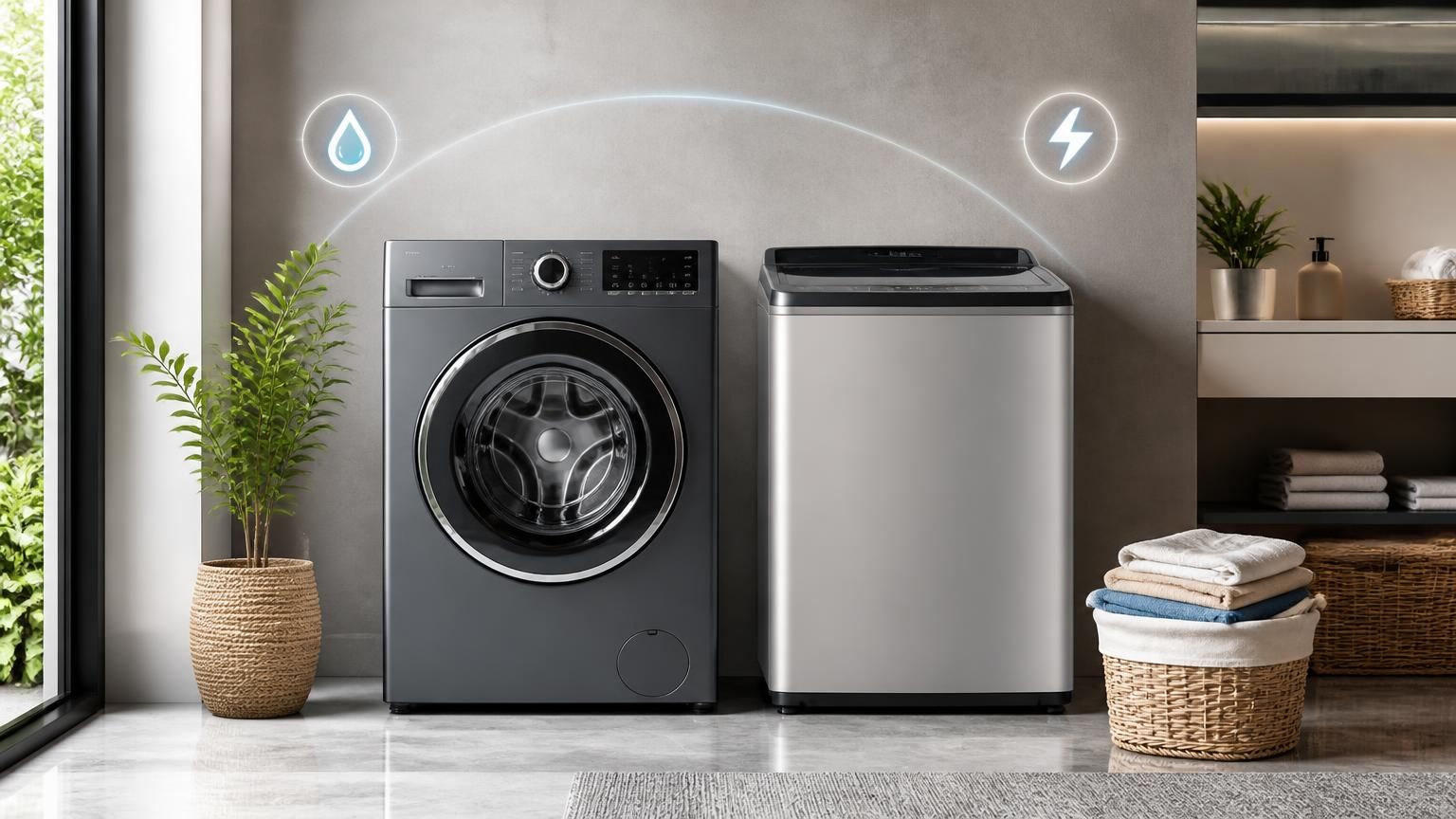
Featured image brief: Create a clean, photorealistic 16:9 editorial image showing a front-load and a top-load washing machine side by side in a modern Indian home laundry area. Include a neatly folded laundry basket and subtle visual cues for water and energy efficiency. No brand logos, readable text, star-rating claims or promotional badges.
Image alt text: Front-load and top-load washing machines compared in a modern Indian home laundry area.