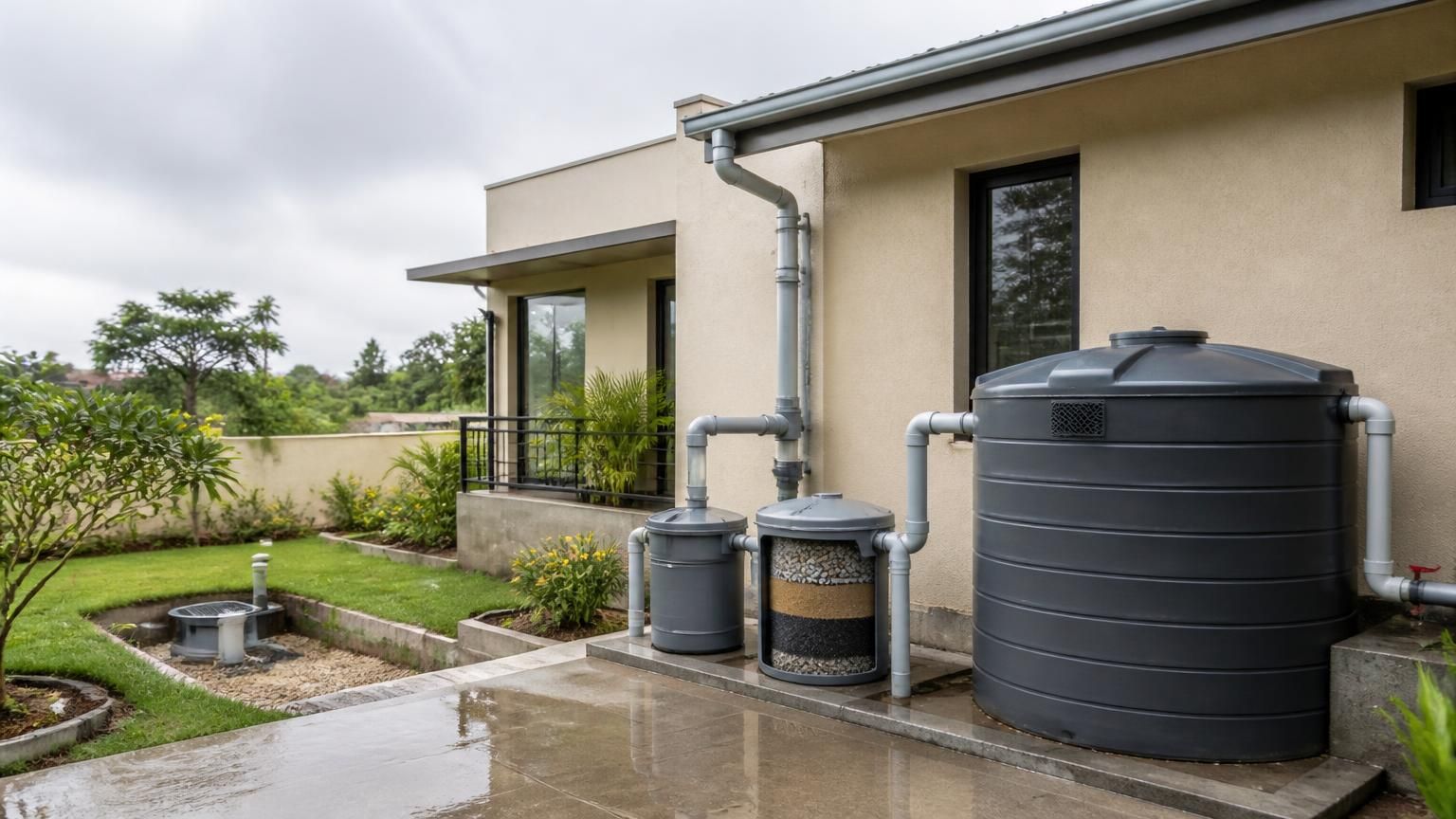
Also distinguish total annual collection from dependable supply. Rain may fall in a few intense weeks while household demand continues through a long dry period. A tank sized to capture one heavy storm is not automatically sized to bridge the dry season. For that reason, a sensible proposal should show both the estimated collection pattern and the intended non-potable demand.
3. Compare the first-flush device and leaf screen
The first rain after a dry period can carry dust, leaves, bird droppings and other roof deposits. A first-flush diverter sends an initial portion of runoff away from the storage or recharge route. It is not a water purifier; it is one part of contamination control.
Look for:
- a diverter sized for the connected roof area and local design rainfall;
- a drain or release point that does not send dirty water back towards the building foundation;
- an accessible clean-out or flushing arrangement;
- a leaf screen at the roof outlet or gutter;
- durable, UV-resistant pipework suitable for outdoor exposure.
The Madhya Pradesh Pollution Control Board's rooftop harvesting guidance identifies catchment, transportation, first flush and filter as core system components. It explains that the first shower should be diverted to remove likely contaminants from the atmosphere and roof surface: https://www.mppcb.mp.gov.in/RWH.aspx
Avoid a kit that includes only a mesh basket and advertises it as a complete first-flush and filtration solution.
Manual or automatic first flush?
A manual arrangement may use a valve or removable diverter that the homeowner operates at the beginning of rainfall. It can be straightforward and inexpensive, but it depends on someone remembering to operate it and reset it correctly. An automatic arrangement uses a chamber or float mechanism to collect an initial volume and then changes the flow path. It can reduce routine intervention, but moving parts, seals and drains still need inspection.
Do not assume that the word “automatic” means maintenance-free. Ask the seller how the chamber empties after a shower, how the float or ball is cleaned, what happens if the outlet blocks and whether replacement parts are available. If the first-flush drain discharges next to the building or into a location that creates dampness, the installation is poorly planned.
4. Choose the filter for the intended use
Filters remove different kinds of material. A leaf screen catches larger debris; a gravel-and-sand chamber reduces suspended solids; a finer treatment stage may be needed for a particular storage or reuse purpose. None of these stages should automatically be treated as proof that water is potable.
| Filter arrangement | Typical role | What to check |
|---|
| Mesh or leaf screen | Stops leaves and larger debris | Mesh access, corrosion resistance and ease of cleaning |
| Gravel and sand chamber | Reduces visible sediment and suspended matter | Correct media grading, washable layers and drainage |
| Cartridge or packaged rainwater filter | Adds a defined filtration stage | Manufacturer's flow rating, replacement interval and compatible cartridges |
| Site-designed recharge filter | Helps protect the recharge structure from debris and sediment | Site-specific design, maintenance access and safe overflow |
Do not select a filter by the number of stages printed on the box. Ask for its rated flow, maintenance method, replacement-media cost and the type of contaminant it is designed to reduce. A filter that is too restrictive can cause roof overflow during heavy rain.
Filter capacity and bypass
The filter must handle the flow reaching it during the design storm. A small domestic cartridge designed for a modest tap flow may not be suitable for a roof downpipe during intense rainfall. Ask the supplier for the rated flow under the conditions that matter, the recommended number of connected downpipes and whether the unit has a safe bypass or overflow route.
A bypass should not silently send untreated water into a drinking-water tank. It should direct excess runoff to a separately planned stormwater route, storage overflow or recharge route that is permitted and suitable for the site. The installer should explain this in plain language before work begins.
Filter media and replacement costs
For a media filter, request the type and grading of each layer, the order in which they are installed and the procedure for washing or replacing them. For a cartridge filter, ask for the exact cartridge model and its current availability. A proprietary filter that is inexpensive to buy but difficult to source later can become an expensive maintenance problem.
A good quotation identifies consumables separately from the initial equipment price. It should not promise that gravel, sand or a cartridge will last indefinitely. Their condition depends on roof cleanliness, local dust, leaf fall, rainfall intensity and the quality of maintenance.
5. Select storage capacity and tank construction carefully
Tank capacity should reflect the expected usable yield, the household's non-potable demand, the length of dry periods and the available space. A very large tank can be an unnecessary expense if the catchment cannot fill it; a small tank may overflow early in the monsoon.
For a storage system, compare:
- opaque construction that limits light entry and algae growth;
- a secure, well-fitting lid and screened inlet/vent openings;
- an accessible manhole for inspection and cleaning;
- a draw-off point positioned to avoid collecting settled sediment;
- a drain or sump arrangement for cleaning;
- an overflow routed away from foundations and neighbouring property;
- a separate pipe network so harvested water cannot accidentally mix with potable municipal supply.
The Eco-Niwas Samhita 2024 specifically describes separate storage and pipeline provisions to avoid mixing harvested water with potable municipal water. Do not connect a rainwater tank directly to drinking-water plumbing without a properly designed, approved treatment and backflow-protection arrangement.
Above-ground tank or underground sump?
An above-ground tank can be easier to inspect, clean and maintain, provided the structure supporting it is designed for the full water load and the location is protected from damage and sunlight. It needs a stable base, a secure lid and a sensible overflow route. Do not place a large water tank on a roof or elevated platform without a qualified structural assessment.
An underground sump can preserve usable space and may protect stored water from direct sunlight, but access, waterproofing, structural design, ventilation and cleaning become especially important. The cover must be secure and safe, and the installation must not allow surface runoff or sewage to enter. Excavation should be checked for buried services and nearby foundations.
The right choice depends on the property and the intended use. A supplier should state the tank's usable capacity, material, installation requirements, cleaning access and warranty conditions. Compare the total installed cost rather than only the tank's advertised price.
6. Recharge pits need a site assessment
A recharge pit, trench or well is not a universal accessory that can be installed at any depth. Soil permeability, local groundwater conditions, contamination risks, nearby septic systems and underground utilities all matter. A site with clay-heavy soil may behave very differently from one with permeable sandy soil.
Ask the installer to explain:
- why the proposed recharge structure suits the soil and site;
- how silt and debris will be intercepted before water enters it;
- how the structure will be inspected and desilted;
- how overflow will be handled during intense rainfall;
- how sewage lines, septic tanks and other contamination sources will be kept separate.
The Ministry of Jal Shakti FAQ describes recharge pits and filtration as part of rooftop harvesting, while the BEE code points to local by-laws and the relevant site conditions. Obtain local authority guidance before construction, particularly where groundwater recharge permissions or building rules apply.
Do not choose pit depth from a catalogue
A deeper pit is not automatically a better pit. The design should reflect the soil profile, groundwater conditions, available footprint and the method of recharge. A generic “standard depth” advertised online cannot replace a site assessment. Where the site has a high water table, poor infiltration, contaminated soil or nearby sanitation infrastructure, the proposed recharge method may need to change or may not be appropriate.
Request a drawing that shows the inlet, silt trap, filter media, inspection access and overflow. Ask who is responsible for cleaning the pit after silt accumulates. If the contractor cannot explain how the structure will be maintained, the design is incomplete.
7. Maintenance is part of the purchase decision
A system that cannot be cleaned safely will gradually lose performance. Before paying, check that the design allows access to every screen, diverter, filter and tank opening.
| Timing / trigger | Maintenance action |
|---|
| Before the monsoon | Clean the roof and gutters; inspect downpipes, screens and first-flush devices |
| At the start of rainfall | Confirm the first-flush diversion is working and dirty runoff is not entering storage |
| During the rainy season | Remove leaves and sediment; check for leaks, overflow and blocked outlets |
| After the monsoon | Clean filter media as specified and inspect the tank and recharge route |
| Before using stored water | Test quality according to the intended use; do not assume clear water is safe to drink |
The National Centre for Disease Control's guidance for rainwater harvesting stresses covered tanks, screened inlets, exclusion of light, coarse filtration and regular maintenance. It also advises cleaning the catchment and filter materials before the monsoon: https://ncdc.mohfw.gov.in/uploads/pdf/Green5.pdf
If stored rainwater is intended for drinking, arrange appropriate testing and treatment. The BEE code refers to regular testing against the applicable drinking-water quality requirements, particularly for potable use. Visual clarity, a household TDS meter or a simple filter cartridge is not a substitute for microbiological and chemical testing.
A practical maintenance log
Keep a simple record of when the roof and gutters were cleaned, when the first-flush chamber was emptied, when filter media were washed or replaced, when the tank was inspected and when water samples were tested. Note unusual colour, odour, sediment or a sudden reduction in flow. This makes it easier to identify whether a problem is caused by a blocked screen, dirty media, a leaking pipe or contamination in the storage tank.
Do not enter a tank or underground sump to clean it yourself. Confined spaces can present serious hazards, including oxygen deficiency and toxic gases. Use a competent service provider with suitable procedures and equipment. Isolate pumps and electrical equipment before maintenance, and keep children away from open tanks and pits.
8. Compare quotations on a like-for-like basis
Rainwater-harvesting quotes often bundle different components, making a simple total-price comparison misleading. One installer may include gutters, first flush, filter and storage; another may quote only a filter and a short pipe connection.
Ask each supplier to list:
- measured roof area and connected downpipes;
- pipe material, diameter and approximate route;
- leaf screens and first-flush arrangement;
- filter type, rated flow and media or cartridge details;
- storage tank capacity and construction, if included;
- recharge structure design and site assumptions, if included;
- overflow route and protection against backflow or cross-connection;
- excavation, civil work, access covers and reinstatement;
- maintenance schedule, consumable costs and service contact;
- warranty coverage and exclusions.
Check whether the quotation includes labour, transport, plumbing fittings, excavation, waterproofing and electrical work for any pump. Ask whether taxes are included and whether the supplier will provide an as-installed drawing. A low initial quote can become more expensive if essential parts are excluded.
Red flags in a product listing or installation quote
Be cautious when a listing promises that rainwater becomes “100% drinking water” through a basic mesh or sand filter; claims a fixed annual collection amount without asking for the roof area and local rainfall; offers one standard tank size for every property; omits the first-flush stage; or has no explanation for overflow and maintenance. Also question a recharge pit quote that gives a fixed depth without discussing soil and groundwater conditions.
9. Questions to ask an installer before accepting a quotation
- Is the quote based on my measured roof catchment and local rainfall?
- What is the estimated collection volume, and what assumptions were used?
- Is the first-flush device included and sized for this roof?
- What is the filter's rated flow and cleaning procedure?
- Is the proposal for storage, recharge or both?
- If recharge is proposed, what site assessment supports it?
- How is overflow routed during heavy rain?
- Are storage and potable-water plumbing kept separate?
- What access is provided for cleaning and inspection?
- Which components need periodic replacement, and what do they cost?
- Will I receive a drawing and a maintenance handover after installation?
- Who should I contact if a filter blocks or a tank begins leaking?
Be cautious of guaranteed annual savings, claims that one small filter makes all rainwater drinkable, or a fixed tank-size recommendation made without measuring the roof and understanding household use.
Purchase checklist
- [ ] Confirm the objective: storage, recharge or a properly designed combination.
- [ ] Measure the roof area actually connected to the system.
- [ ] Use local rainfall data and state the assumptions in the yield estimate.
- [ ] Check gutters, downpipes and leaf screens.
- [ ] Include a serviceable first-flush arrangement.
- [ ] Match filter flow capacity to the connected catchment and rainfall.
- [ ] Select tank capacity based on yield and intended demand.
- [ ] Keep the tank covered, opaque and accessible for cleaning.
- [ ] Obtain a site assessment before choosing a recharge pit or well.
- [ ] Keep harvested-water plumbing separate from potable-water plumbing.
- [ ] Plan overflow, inspection, maintenance and water testing.
- [ ] Compare complete installed quotations, not just kit prices.
Frequently asked questions
Can rainwater from a roof be used directly for drinking?
Do not assume it is safe. Roof runoff can contain biological and chemical contaminants. Potable use requires appropriate treatment, safe storage and testing against applicable drinking-water requirements.
Is a first-flush diverter necessary?
It is an important contamination-control component in many rooftop systems because it diverts the initial runoff carrying roof deposits. Its sizing and operation should be matched to the roof and local conditions.
Is a packaged rainwater filter enough?
Not by itself. The system also needs suitable catchment drainage, leaf screening, first flush, maintenance access and a properly designed storage or recharge destination.
Should I choose a storage tank or a recharge pit?
Choose based on your objective, local rules, site conditions and water demand. A combined system may be possible, but it needs deliberate overflow and routing design.
Does a larger tank always collect more rainwater?
No. It can store more only if enough water reaches it. Catchment area, rainfall, runoff losses and household demand determine whether additional capacity is useful.
Can a rainwater harvesting kit be installed without a professional?
Simple components may be straightforward, but roof drainage, tank loading, underground excavation, recharge design and potable-water separation can affect building safety and water quality. Use a qualified installer for design-sensitive work and check local rules.
How often should the filter be cleaned?
There is no single interval suitable for every property. Follow the filter manufacturer's instructions and inspect more frequently during periods of heavy leaf fall, dust or intense rainfall. A blocked filter can cause overflow and reduce collection.
Final verdict
Buy a rooftop rainwater harvesting system as a complete, maintainable design—not as a filter kit selected from a product listing. Measure the catchment, estimate local yield, include leaf screening and first flush, choose filtration for the intended use, and decide separately whether storage or groundwater recharge is appropriate. Insist on safe overflow, accessible cleaning points and separation from potable plumbing. A well-designed system should be explainable component by component, with no promise that untreated roof water is automatically drinking water.