
Stop Forgotten Subscription Charges: What RBI's 2026 E-Mandate Rules Mean for Your Recurring Payments
A music subscription, streaming plan, insurance premium, mutual-fund contribution or other recurring payment can quietly renew month after month. If you forget that a mandate is active, the next debit may come as an unpleasant surprise.
The Reserve Bank of India (RBI) issued the Digital Payments – E-mandate Framework, 2026 on 21 April 2026. It consolidates the rules for recurring transactions made using cards, prepaid payment instruments (PPIs) and UPI. The framework sets requirements for mandate registration and revocation, pre-transaction alerts, opt-outs, authentication and transaction limits.
This guide explains what the rules mean for consumers and how to use them to keep track of subscriptions and automatic payments.
1. What is an e-mandate?
An e-mandate is an instruction you give to a bank or payment provider to allow future recurring payments to a merchant or biller. Instead of entering payment details every time, the recurring transaction is processed under the mandate you registered.
Common examples can include:
- Streaming, music and app subscriptions.
- Recurring insurance premium payments.
- Mutual-fund subscription payments.
- Credit-card bill payments.
- Other recurring merchant payments using an eligible card, PPI or UPI arrangement.
The framework applies to payment system providers and participants processing domestic or cross-border recurring transactions using cards, PPIs and UPI.
A mandate is not the same thing as a one-time card payment. It creates an ongoing payment instruction with a validity period and defined conditions.
2. The 24-hour pre-debit notification: what should you receive?
One of the most important consumer protections is the pre-transaction notification.
RBI says the issuer must send the customer a notification at least 24 hours before the actual charge or debit. The alert must include, at a minimum:
1. The merchant's name.
2. The transaction amount.
3. The date and time of the debit.
4. The e-mandate reference number.
5. The reason for the debit—that it is an e-mandate registered by the customer.
The notification channel can be among the options made available by the issuer, such as SMS or email. RBI's framework says customers should be able to choose or change the available notification mode.
What should you do when the alert arrives?
- Check whether you recognise the merchant.
- Compare the amount with the subscription or bill you agreed to.
- Confirm the scheduled debit date.
- Check whether the amount is within any maximum value you set for a variable mandate.
- If you no longer want the debit, use the issuer's opt-out facility and complete the required authentication.
Do not ignore a notification simply because the merchant name looks unfamiliar. Some services use a parent company, payment processor or legal entity name that differs from the app or brand name you remember. Check your subscription account and bank records before deciding whether the debit is legitimate.
3. You can opt out of a particular debit or withdraw the mandate
RBI's framework requires the issuer to provide a facility for the customer to opt out of any particular recurring transaction or the e-mandate itself. The opt-out must be validated by the issuer using an additional factor of authentication (AFA), and an intimation must be sent to the customer.
The framework also says that a customer can modify the validity period or withdraw an e-mandate at any point. Modification or withdrawal of an existing mandate requires AFA validation by the issuer.
Opting out of one debit vs withdrawing the entire mandate
| Action | What it means |
|---|---|
| Opt out of a particular transaction | Stop one scheduled debit while leaving the wider mandate in place, subject to the issuer's process |
| Withdraw the e-mandate | Revoke the ongoing payment authority so future recurring debits under that mandate should no longer be processed |
| Modify the mandate | Change supported mandate details, such as validity period or the maximum value for a variable mandate, using the issuer's authenticated process |
If you only want to skip one month's payment, a one-transaction opt-out may be appropriate. If you have cancelled the subscription permanently, withdrawing the mandate is the more complete step.
Important: Stopping a bank mandate and cancelling a subscription are not necessarily the same action. You may still owe money under the merchant's contract or cancellation policy. Cancel the service with the merchant as well, and keep the confirmation.
4. How mandate registration and authentication work
The framework requires a one-time registration process for a customer who wants to use an e-mandate. The mandate is registered only after successful validation of an additional factor of authentication, in addition to the normal process required by the issuer.
Each mandate must specify a validity period. The issuer must provide a facility to modify that period or withdraw the mandate at any point and communicate this facility to the customer at registration.
A mandate can be:
- For a pre-specified fixed amount; or
- For a variable amount, subject to the overall cap fixed by RBI.
For a variable mandate, the issuer must provide a facility for the customer to specify the maximum value of any recurring transaction.
The first transaction under an e-mandate requires AFA validation. If the first transaction is processed at the same time as mandate registration, the authentication may be combined.
Why this matters
A recurring payment should not be treated as permission for an unlimited amount to be taken whenever a merchant chooses. The mandate's validity and amount conditions matter. Review these details when you first authorise a recurring payment, particularly if the amount can vary.
5. RBI's recurring-payment authentication limits
The framework states that recurring transactions may be authorised without AFA up to ₹15,000 per transaction. Recurring transactions above that amount are subject to AFA.
It provides a higher threshold for certain categories: insurance premiums, mutual-fund subscriptions and credit-card bill payments may be made without AFA up to ₹1,00,000 per transaction.
| Recurring payment type | Threshold stated in RBI framework |
|---|---:|
| General recurring transactions | Up to ₹15,000 per transaction may be authorised without AFA |
| Insurance premiums | Up to ₹1,00,000 per transaction may be authorised without AFA |
| Mutual-fund subscriptions | Up to ₹1,00,000 per transaction may be authorised without AFA |
| Credit-card bill payments | Up to ₹1,00,000 per transaction may be authorised without AFA |
These are authentication thresholds, not a statement that every transaction below the threshold is guaranteed to go through. The mandate must still be valid, the issuer and payment system must process it correctly, and other applicable controls can apply.
A payment above the relevant threshold may require an additional authentication step. Do not assume that a recurring payment will always be completed automatically just because you registered a mandate earlier.
6. Post-transaction alerts and grievance redressal
The issuer must also send a post-transaction notification after a recurring payment. The notification must include, at a minimum:
- Merchant name.
- Transaction amount.
- Date and time of debit.
- Transaction reference number and e-mandate reference number.
- Reason for the debit.
- Details of grievance redressal.
The framework also requires issuers to have an appropriate dispute-resolution system so customers can lodge grievances. RBI's instructions on limiting customer liability for unauthorised transactions apply to recurring transactions under e-mandates as well.
If you see a debit you do not recognise:
1. Check the post-transaction notification and mandate reference.
2. Contact the bank or payment provider using its official app, website or phone number.
3. Raise a dispute promptly and retain the complaint reference.
4. If the mandate is no longer wanted, use the authenticated withdrawal process.
5. Cancel the subscription with the merchant separately if you no longer want the service.
Do not share OTPs, PINs, passwords or full card details with anyone claiming to help reverse a debit.
7. Are there any exceptions?
Yes. RBI says the pre-transaction notification is not required for e-mandates registered to auto-replenish balances of FASTag and the National Common Mobility Card (NCMC).
This is a specific exception to the pre-transaction notification requirement. It should not be generalised to ordinary streaming, shopping, insurance or other subscription payments.
The framework also says no charges shall be levied to the customer for availing the e-mandate facility for recurring transactions.
8. A practical subscription and auto-debit audit
Even with notification and opt-out protections, the best approach is to review active mandates regularly.
Step 1: Make a list of recurring payments
Check your bank account statements, card statements, UPI app mandate section, email receipts and subscription dashboards. Record:
- Merchant or service name.
- Approximate amount.
- Billing frequency.
- Next expected debit date.
- Card, account, PPI or UPI source.
- Whether you still use the service.
Step 2: Match every payment to a service
Look for forgotten free trials, duplicate subscriptions, old family plans, annual renewals and services that are no longer used.
Step 3: Cancel unwanted subscriptions with the merchant
Use the merchant's official cancellation process. Save the cancellation email or reference number.
Step 4: Withdraw the payment mandate
Open the bank, card issuer or UPI app's mandate-management section. Locate the correct mandate and follow the authenticated withdrawal process. The menu wording varies by provider.
Step 5: Check the next statement
Confirm that future recurring debits have stopped. If a charge still appears after cancellation or withdrawal, contact the issuer and merchant with the saved reference numbers.
Step 6: Keep a simple renewal calendar
For services you want to retain, record the next renewal date and amount. Review the list once a month or before major annual renewals.
9. What consumers should remember
- A pre-debit alert should arrive at least 24 hours before a covered recurring debit.
- The alert should identify the merchant, amount, debit date/time, mandate reference and reason.
- You should have a way to opt out of a particular debit or withdraw the mandate, with AFA validation.
- A mandate has a validity period and can be modified or withdrawn using the issuer's process.
- General recurring transactions up to ₹15,000 may be authorised without AFA; certain specified categories have a ₹1,00,000 threshold.
- Post-transaction notifications and grievance redressal are also part of the framework.
- FASTag and NCMC auto-replenishment mandates are exempt from the pre-transaction alert requirement.
- Cancelling a subscription with the merchant and withdrawing the bank mandate are separate tasks.
Frequently Asked Questions
1. What is the RBI E-mandate Framework, 2026?
It is RBI's framework for recurring digital payments made through cards, PPIs and UPI. It covers mandate registration, revocation, notifications, authentication thresholds and grievance redressal.
2. How early should a bank notify me before an automatic debit?
The issuer must send the pre-transaction notification at least 24 hours before the actual charge or debit, except for the specified FASTag and NCMC auto-replenishment exception.
3. What details should the pre-debit alert contain?
At a minimum, the merchant name, transaction amount, debit date and time, e-mandate reference number and reason for the debit.
4. Can I stop just one recurring payment?
Yes. RBI's framework requires an issuer facility to opt out of a particular transaction or the e-mandate. The opt-out is subject to AFA validation.
5. Can I cancel an entire e-mandate?
Yes. The issuer must provide a facility to withdraw the mandate at any point. Withdrawal or modification requires AFA validation.
6. What is the ₹15,000 limit?
Recurring transactions up to ₹15,000 per transaction may be authorised without AFA under the framework. Transactions above this amount are subject to AFA.
7. Do insurance and mutual-fund payments have a different threshold?
Yes. Insurance premiums, mutual-fund subscriptions and credit-card bill payments may be made without AFA up to ₹1,00,000 per transaction under the framework.
8. Does the rule cover UPI AutoPay?
The framework applies to recurring transactions using cards, PPIs and UPI. UPI recurring mandates therefore fall within its stated scope.
9. Do I need to cancel the subscription as well as the mandate?
If you no longer want the service, yes. Cancelling the merchant subscription and withdrawing the payment mandate are separate actions. Complete both and retain the confirmations.
10. Are FASTag and NCMC auto-replenishment payments covered by the 24-hour alert rule?
RBI specifically exempts e-mandates registered for auto-replenishment of FASTag and NCMC balances from the pre-transaction notification requirement.
Final Verdict: Treat every mandate like a recurring bill you actively manage
RBI's 2026 framework gives consumers clearer visibility and control over recurring digital payments. The 24-hour pre-debit notification, the ability to opt out of a particular debit, mandate withdrawal and post-transaction alerts make it easier to spot unwanted renewals and take action.
But the protection works best when you review your active mandates, cancel subscriptions you no longer use and keep a record of each withdrawal. Do not rely only on an alert arriving in your inbox. A monthly five-minute review of bank, card and UPI mandates can help prevent forgotten charges from becoming a recurring drain on your budget.
---
Official source
1. Reserve Bank of India – Digital Payments – E-mandate Framework, 2026 — Master Direction RBI/DPSS/2026-27/396, dated 21 April 2026.
Editorial note: This article summarises the RBI Master Direction and is not legal or financial advice. For a disputed transaction, contact the issuer or payment provider through official channels and follow the applicable complaint process.
---
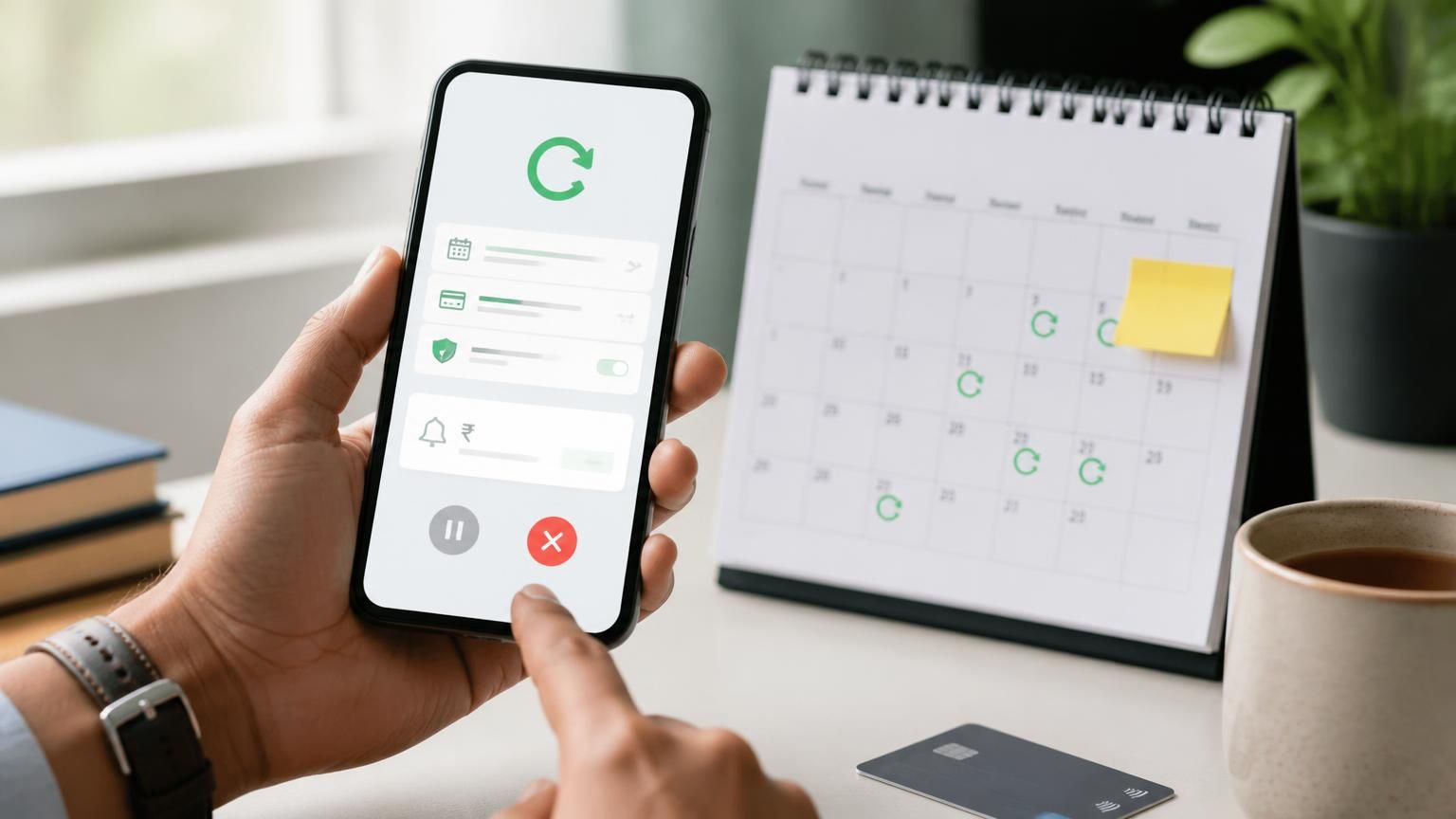
Featured image brief: Create a clean 16:9 editorial illustration for an Indian personal-finance guide. Show a consumer reviewing recurring-payment alerts on a smartphone, a simple monthly calendar with a reminder, and a bank statement with generic unreadable lines. Include a subtle 24-hour clock motif but no fake bank logos, personal data, account numbers or invented payment alerts.
Image alt text: Consumer checking recurring payment alerts and a subscription calendar on a smartphone.