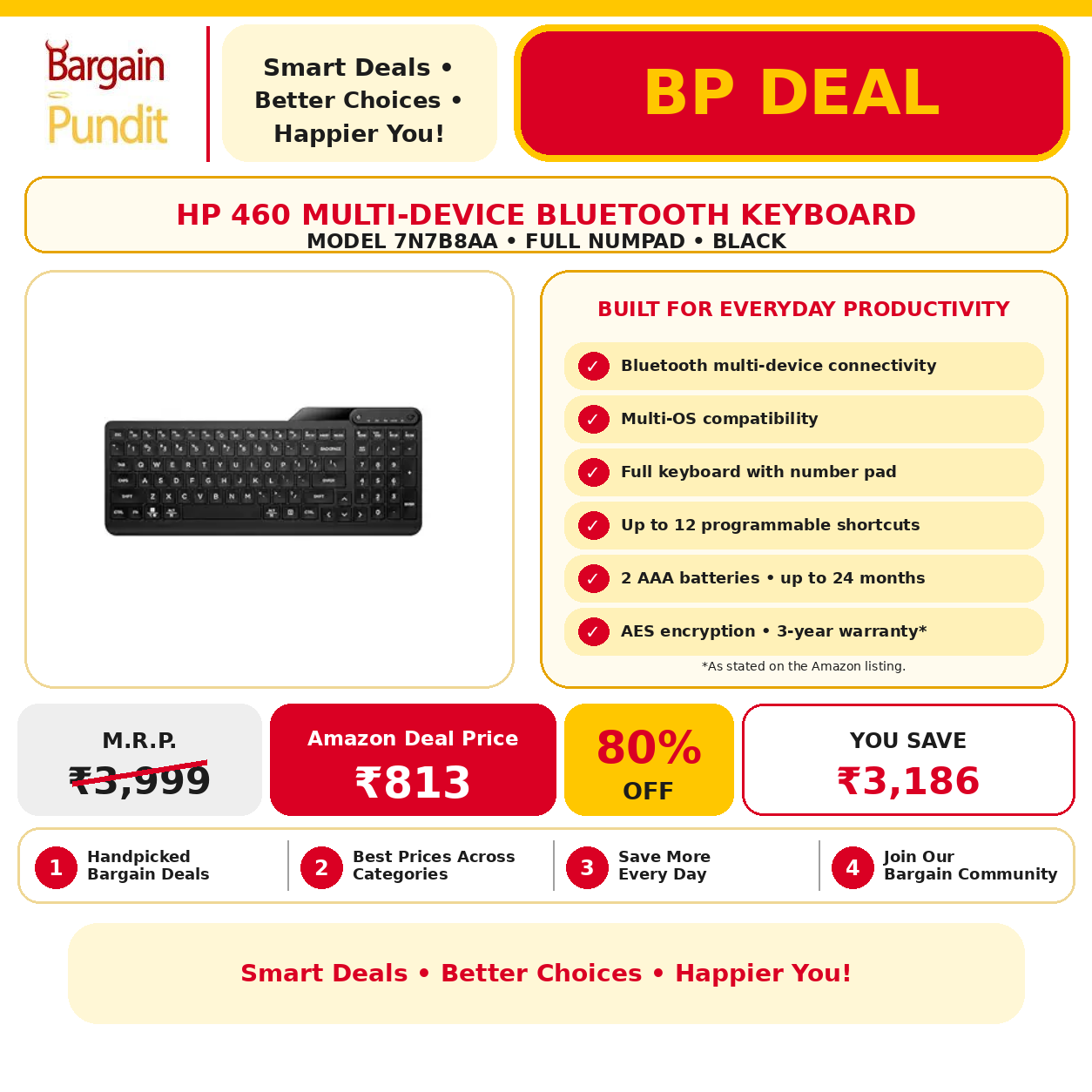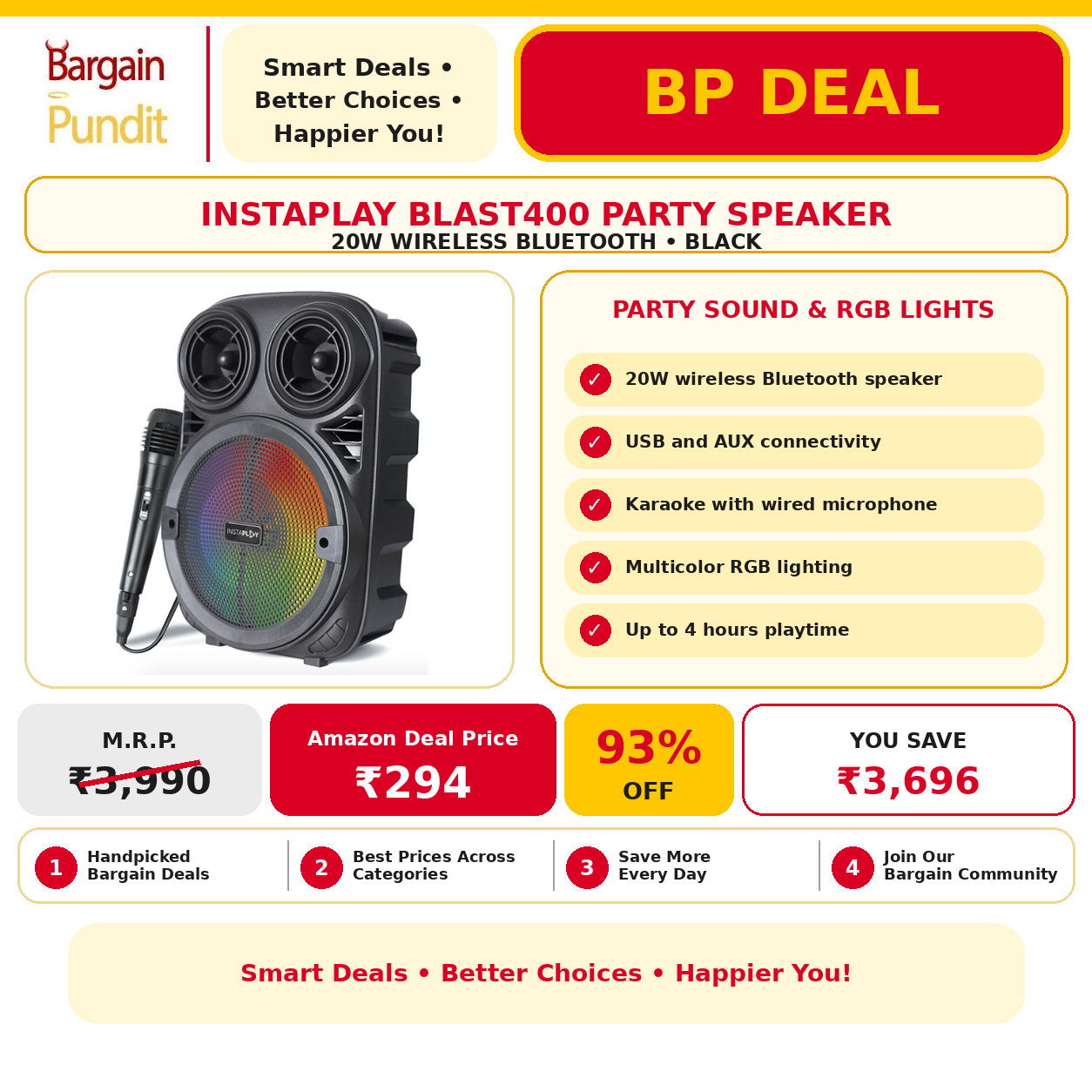

A product marked “70% off” can look like an unmissable bargain. But the discount percentage alone does not tell you whether the selling price is genuinely competitive. The listed MRP may be much higher than the product’s usual selling price, the offer may apply only to selected payment methods, or extra charges may appear at checkout.
The safest way to shop online is to compare the amount you will actually pay for the exact product, from a seller you trust, with clear return and warranty terms. This BP guide explains how to do that in a few practical steps.
Featured image brief: Landscape 16:9 editorial photograph of an Indian shopper at home comparing a product listing on a laptop with a price on a smartphone. Show a neutral, generic e-commerce interface with no brand logos, no readable promotional claims, no exaggerated discount graphics and no watermark.
1. Do not judge a deal by the discount percentage
A discount is usually calculated against a reference price, often the MRP. That does not automatically make the reference price a useful indicator of the product’s normal market value.
For example, consider a product with an MRP of ₹10,000 and a displayed selling price of ₹5,999. The listing may advertise a 40% discount. But if the same product has commonly sold for ₹6,199, the real saving against its recent street price is only ₹200—not ₹4,001.
Use the percentage as a starting point, not as proof of a bargain.
BP tip: Ask two questions: “What is the price today?” and “What has this exact model typically sold for recently?”
2. Check the price history where possible
For products that you do not need immediately, observe the price over time. Price-tracking websites and browser tools can help show historical changes for selected product pages. Their data may be incomplete or may not cover every seller, variant, coupon or checkout offer, so use them as an additional reference rather than as an absolute record.
A sensible check:
- Search the exact model number, not just the product family.
- Compare the same colour, storage, capacity or size.
- Look at more than one retailer.
- Check whether the current price is genuinely lower than recent prices.
- Recheck the final checkout amount, because coupons and bank offers may not appear in the listing price.
If a product’s “original price” seems unusually high compared with several established retailers, treat the advertised percentage with caution.
3. Compare the exact model—not just the product name
Retailers sometimes list similar products with slightly different specifications. A phone with 128 GB storage is not the same deal as its 256 GB version. A washing machine with a different model suffix may have a different motor, wash programme or warranty.
Before comparing prices, verify:
- Manufacturer and full model number.
- Storage, RAM, size, capacity or configuration.
- Model year or generation, where relevant.
- Included accessories and bundled items.
- Warranty type and who provides after-sales service.
A lower price is not necessarily better value if it is for an older variant or a different specification.
4. Calculate the real checkout price
The product page price is not always the amount charged to your payment method. Delivery fees, platform fees, installation charges, convenience charges or optional add-ons can change the total.
Use this simple calculation:
Effective purchase cost = listed selling price − instant discounts − coupon discounts + mandatory fees
Keep cashback separate. Cashback is usually credited later and may depend on eligibility, transaction type, caps or a future crediting date. Do not subtract it from the immediate payment unless the offer explicitly reduces the checkout amount.
Example: headline discount versus actual saving
| Item | Retailer A | Retailer B |
|---|---:|---:|
| Displayed selling price | ₹5,999 | ₹5,799 |
| Eligible instant bank discount | −₹500 | — |
| Coupon | — | −₹100 |
| Delivery/mandatory fee | ₹0 | ₹99 |
| Payable at checkout | ₹5,499 | ₹5,798 |
In this example, Retailer A is cheaper at checkout even though Retailer B shows a lower selling price. The calculation assumes the cardholder qualifies for the bank offer and the offer is confirmed at payment.
5. Read the bank and coupon terms carefully
A banner saying “10% instant discount” does not mean every customer or every product receives 10% off.
Check the offer terms for:
- Eligible bank and card type.
- Credit card versus debit card eligibility.
- Minimum transaction amount.
- Maximum discount cap.
- Eligible product categories and excluded sellers.
- Full-swipe versus EMI conditions.
- Offer dates and time zone, if specified.
- Whether the coupon must be selected before checkout.
- Whether the offer can be combined with another promotion.
Do not assume that a cashback benefit is an instant discount. If an offer is unclear, check the bank’s official offer page and the retailer’s payment screen before ordering.
6. Watch for urgency messages and other dark patterns
Messages such as “Only 2 left”, “Sale ends in 5 minutes” or repeated countdowns can pressure shoppers into acting before checking the details. A countdown or low-stock message is not, by itself, proof that the deal is false; however, consumers should not let urgency replace verification.
The Department of Consumer Affairs’ Guidelines for Prevention and Regulation of Dark Patterns, 2023 identify deceptive interface practices such as false urgency, basket sneaking, confirm shaming, drip pricing, bait and switch, disguised advertisements and subscription traps.
Look out for these examples:
- False urgency: repeated countdowns or scarcity prompts that pressure immediate action.
- Basket sneaking: an add-on or service appears in the basket without clear consent.
- Drip pricing: mandatory charges are revealed only late in the purchase journey.
- Bait and switch: the advertised product or price is not actually available and a different option is pushed.
- Disguised advertisement: paid or sponsored placement is not clearly identified.
Review your basket line by line before paying. Remove anything you did not intentionally select.
Official reference: Department of Consumer Affairs – Guidelines and information on dark patterns.
7. Check the seller, returns and warranty—not only the platform
A familiar marketplace may host multiple sellers. Check the seller name, seller information, product reviews and the return or replacement policy for the specific listing.
Before buying, confirm:
- Whether the seller is authorised, where the manufacturer provides an authorised-seller list.
- Whether the invoice will be issued in the correct name.
- Whether the product is new, refurbished or open-box.
- Return, replacement and refund conditions.
- Manufacturer warranty and service-centre coverage.
- Delivery estimate and any installation requirement.
Read recent reviews critically. Look for reviews that describe the exact model and variant. A high average rating can conceal complaints about a different version or seller.
8. Understand what Indian consumer rules say
The Consumer Protection Act, 2019 applies to consumer transactions including purchases made electronically. It provides a framework against unfair trade practices and misleading advertisements. The National Consumer Helpline explains consumer rights such as the right to be informed, the right to choose, the right to be heard and the right to seek redressal.
The Central Consumer Protection Authority’s 2022 guidelines address misleading advertisements and endorsements. A claim should not create a false impression or hide material information that a consumer needs to make an informed decision.
The Department of Consumer Affairs also publishes the 2023 dark-pattern guidelines, which address deceptive online design practices.
Important update for shoppers: The Government announced the Consumer Protection (E-Commerce) (Amendment) Rules, 2026, which are scheduled to come into force on 1 January 2027. The announced amendments include requirements relating to prior-price display for announced price reductions, sponsored-listing disclosures, search-result transparency and additional seller/product information. These are upcoming requirements as of November 2026; do not describe them as already in force before their commencement date.
Official references:
- Consumer Protection Act, 2019 – National Consumer Helpline knowledge base
- CCPA Guidelines for Prevention of Misleading Advertisements and Endorsements, 2022 – PIB release
- Consumer Protection (E-Commerce) Amendment Rules, 2026 – PIB announcement
- Department of Consumer Affairs – Legal Metrology Act and rules
9. What to do if you believe a deal or listing is misleading
First, save evidence. Keep screenshots of the product page, advertised price, offer terms, seller details, checkout breakdown, order confirmation and communications with customer support. Note the date and time.
Then:
1. Contact the marketplace or seller through its official support channel and explain the issue.
2. Keep the complaint or ticket number and copies of the response.
3. If the issue is not resolved, contact the National Consumer Helpline through consumerhelpline.gov.in or call 1915 (check current operating hours on the official portal).
4. For a formal consumer dispute, review the e-Jagriti consumer commission filing portal: e-Jagriti.
The appropriate route depends on the facts and the remedy sought. A disappointing discount is not automatically a legal violation; misleading representations, undisclosed charges or unfair practices may raise consumer-protection concerns.
10. BP’s 60-second pre-payment checklist
Before you place the order, check each item:
- [ ] Exact model number and variant match.
- [ ] Current price compared with other reputable sellers.
- [ ] Recent price history checked where available.
- [ ] Bank offer and coupon eligibility confirmed.
- [ ] Final payable amount checked after mandatory fees.
- [ ] Cashback kept separate from instant savings.
- [ ] Seller, invoice and warranty details reviewed.
- [ ] Return, replacement and refund terms understood.
- [ ] No unwanted add-ons in the basket.
- [ ] Screenshots saved for any unusually strong offer.
Frequently asked questions
How can I tell whether an online discount is genuine?
Compare the exact product variant across multiple retailers and check its recent price where reliable history is available. Calculate the final checkout amount after eligible instant discounts and mandatory fees. Do not rely only on the MRP percentage.
Is a large discount on MRP necessarily misleading?
Not necessarily. MRP is a reference ceiling for a packaged product, but the discount percentage may not reflect the product’s usual market price. Compare the actual selling price with recent prices for the same model.
Are online price-tracking websites always accurate?
No. They may have incomplete coverage, miss coupons or bank offers, or track a different variant. Use them as one input and verify the retailer’s live listing and checkout.
Is cashback the same as an instant discount?
No. An instant discount reduces the amount payable at checkout. Cashback is generally credited later and may have conditions, limits or a waiting period.
What are dark patterns in online shopping?
Dark patterns are deceptive design practices that manipulate or subvert consumer choice. The Indian 2023 guidelines identify practices including false urgency, basket sneaking, drip pricing and disguised advertisements.
Where can I complain about a misleading online shopping offer?
Start with the seller or marketplace and retain the complaint record. If unresolved, approach the National Consumer Helpline at consumerhelpline.gov.in or 1915. For a formal consumer dispute, review the e-Jagriti portal.
Do the 2026 e-commerce amendments apply already?
The Government announcement states that the Consumer Protection (E-Commerce) (Amendment) Rules, 2026 come into force on 1 January 2027. Until then, distinguish the existing framework from the announced upcoming provisions.
The BP verdict
A genuine bargain is the lowest sensible total cost for the exact product from a seller you are comfortable buying from—not necessarily the biggest percentage printed on a banner. Compare model numbers, check recent prices, read bank-offer conditions, inspect the checkout total and understand the return and warranty terms. Taking one extra minute before payment can prevent an impulsive purchase that was never a real saving.
Bargain Pundit provides general consumer information and is not a legal adviser. Rules and platform terms can change; check the linked official sources for the latest position. Retailer prices and offers vary by product, seller, location, payment method and date.
Sources and further reading
- Department of Consumer Affairs: https://consumeraffairs.gov.in/
- National Consumer Helpline, Consumer Protection Act knowledge base: https://consumerhelpline.gov.in/public/knowledgebasedetails/Consumer%20Protection%20Act%202019
- PIB, CCPA misleading advertisement guidelines (10 June 2022): https://www.pib.gov.in/Pressreleaseshare.aspx?PRID=1832906&lang=2®=48
- PIB, E-Commerce Rules Amendment 2026 announcement (10 September 2026): https://www.pib.gov.in/PressReleasePage.aspx?PRID=2308759&lang=2®=48
- Department of Consumer Affairs, Legal Metrology Act: https://consumeraffairs.gov.in/pages/legal-metrology-act
- National Consumer Helpline: https://consumerhelpline.gov.in/
- e-Jagriti: https://e-jagriti.gov.in/